Do you ask for 'enzymes homework tes'? You can find all the material on this web page.
Table of contents
- Enzymes homework tes in 2021
- Enzymes worksheet pdf
- Enzymes worksheet gcse
- Enzymes lesson
- How enzymes work
- Enzymes tes
- Enzymes homework tes 07
- Enzymes homework tes 08
Enzymes homework tes in 2021
 This image shows enzymes homework tes.
Enzymes worksheet pdf
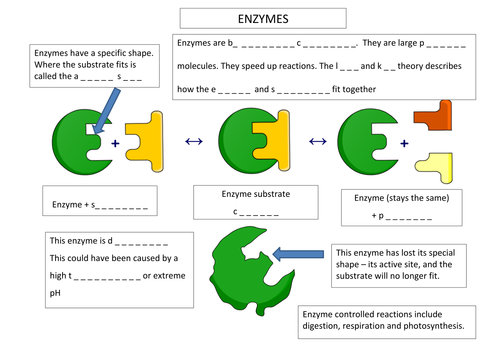 This image representes Enzymes worksheet pdf.
Enzymes worksheet gcse
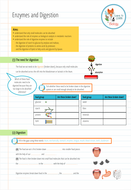 This picture illustrates Enzymes worksheet gcse.
Enzymes lesson
 This picture illustrates Enzymes lesson.
How enzymes work
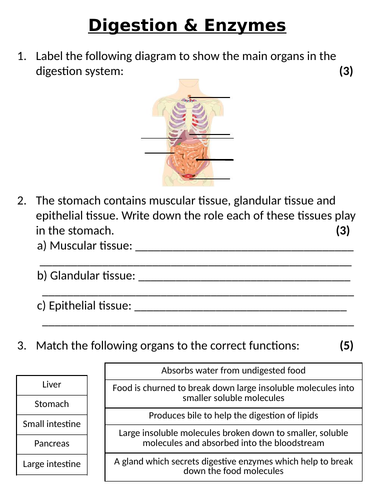 This image demonstrates How enzymes work.
Enzymes tes
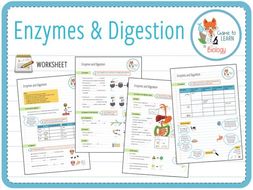 This image demonstrates Enzymes tes.
Enzymes homework tes 07
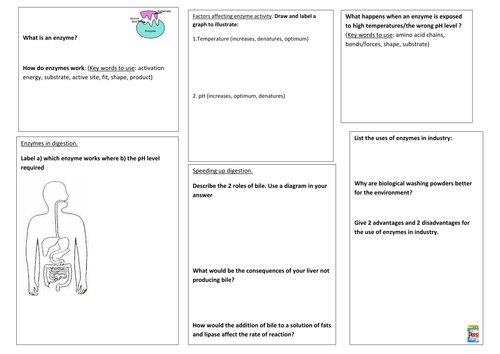 This image illustrates Enzymes homework tes 07.
Enzymes homework tes 08
 This picture demonstrates Enzymes homework tes 08.
How are enzymes used to speed up chemical reactions?
Overview: enzymes are protein molecules that act as catalysts, speeding up chemical reactions without themselves getting used up. Each enzyme will only speed up a specific reaction, for example, catalase will speed up the decomposition of hydrogen peroxide into water and oxygen but it will not speed up the breakdown of starch into glucose.
What happens when the shape of an enzyme changes?
When the shape of an enzyme changes we call this denaturation. Any factor that increases the frequency of collisions between enzymes and substrates (increasing concentration, surface area or temperature) will increase the rate of reaction.
What can I do with my knowledge of enzymes?
The Protein Data Bank provides some beautiful structures of enzymes. GCSE activity for students to apply their knowledge of enzymes. Students work in pairs to apply their understanding of factors that affect enzymes. They will need to consider pH, temperature and enzyme specificity.
What are the active sites of an enzyme?
Enzymes (e.g. catalase) have active sites with specific shapes that bind to the substrate molecule (e.g. hydrogen peroxide) forming an enzyme-substrate complex. The enzyme-substrate complex then breaks down into the enzyme and product, allowing the enzyme to go on and react with another substrate molecule.
Last Update: Oct 2021